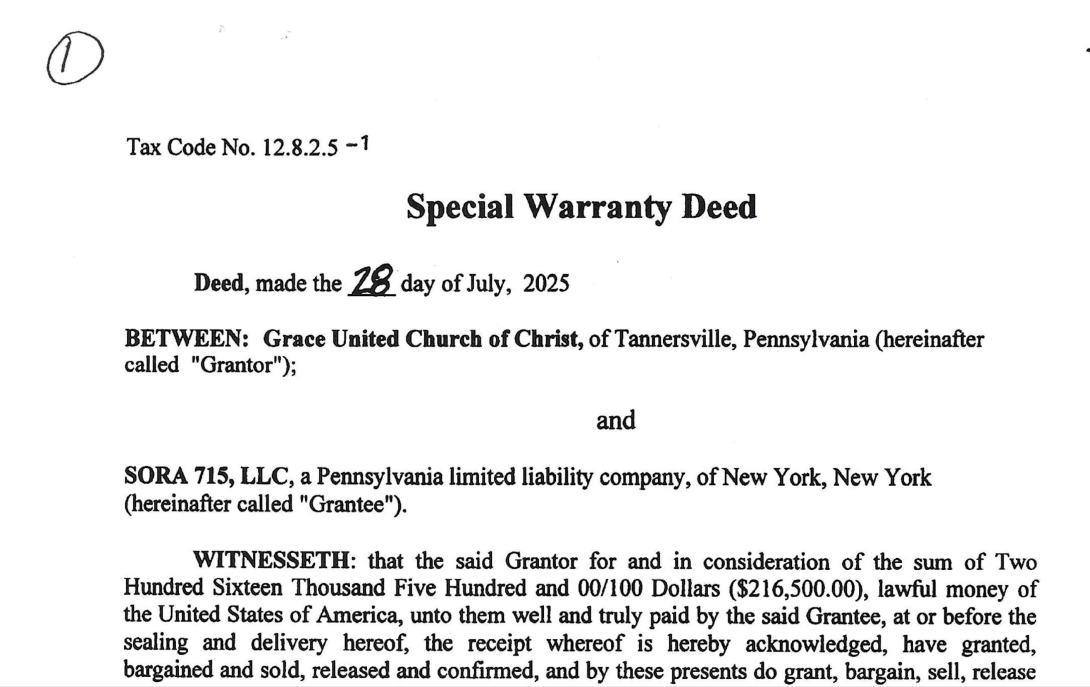
TANNERSVILLE, PA — What began as a straightforward real estate sale to fund cemetery upkeep has become the center of a growing controversy involving potential conflicts of interest, questions of legal oversight, and community concern over one of Tannersville’s most historic properties.
A Sale “For Cemetery Care”
Earlier this month, Elizabeth “Betsy” Casciano, a Realtor with Carr Realty of the Poconos, announced on social media that she was the listing agent for the Grace United Church and the adjoining cemetery properties along Sullivan Trail.
She wrote that the sale was “for the sole purpose of raising money to take perpetual care of the cemetery,” adding that “every dime of the proceeds will be placed in a trust maintained by the Tannersville Union Cemetery Committee.”
Casciano emphasized that the buyer “has no intention at this time to bring down the church” and would sign documents “enforced by the sellers’ attorneys and by the state to ensure protection of the cemetery grounds.”
But in the days since, questions have emerged about whether the cemetery committee exists as a legal entity, what form the promised “trust” will take, and whether the process follows Pennsylvania laws governing cemetery management and property transfers.
Concerns About Oversight and Conflicts
Local resident and community advocate Terri [last name withheld for privacy] has been among those scrutinizing the transaction. In messages shared with MonroeCountyPA.com, Terri alleges potential conflicts of interest and procedural irregularities in the handling of the sale.
According to Terri, the listing agent’s husband is employed by Northeast Site Contractors, a regional construction firm that has worked on several major projects across Monroe County. While there is no public record suggesting that the company is directly involved in the church property, the connection raises ethical questions among residents given the growing development pressures in the Tannersville area.
Terri also cited concerns about safety and zoning compliance related to a narrow driveway entrance on the property, which she described as “only about seven feet wide” and exiting directly onto Routes 715 and Sullivan Trail.
She said that discussions with local officials suggested the entrance may not meet current standards and could pose a traffic hazard if the site is redeveloped. “It has to be blocked off as a hazard,” Terri said, adding that a proper land development review “should have been initiated long ago.”
Deed and Transaction Details
A copy of the property deed was reportedly signed by Clair Learn, who, according to Terri, “shouldn’t have signed” based on her role within the church or its trust structure. The deed is expected to be reviewed further once a full copy is available through county land records.
Meanwhile, Terri claims that another potential buyer had been discouraged from purchasing the property after being told it was “full of mold.” However, she said a separate inspection by David Haseney, a local resident, “did not detect any smell of mold.”
These conflicting accounts have fueled local speculation that the church may be undervalued or being steered toward a preferred buyer.
Historical Parallels and Local Development Patterns
Residents also point to prior redevelopment in nearby Swiftwater — where an historic hotel site was razed to make way for apartments built by Empire Construction, a company owned by Anthony Maula, brother of State Senator Rosemary Brown.
Some fear the Grace United Church could face a similar fate if preservation safeguards are not clearly established.
While these claims have not been substantiated with direct evidence connecting the parties, the pattern of concern — involving developers, political families, and older community properties — has prompted calls for greater transparency and state oversight.
Community Response
Several local residents have expressed willingness to contribute funds to legal and preservation efforts aimed at protecting the cemetery and maintaining the church as a historic site. Terri said she and others, including Sara Katz, David Haseney, and Lynn Deiter, are forming a group to “take over care and maintenance of the three graveyards there and the one on Learn Road, out of respect for the people who built Tannersville.”
Legal and Ethical Review
Under Pennsylvania law, any proceeds from the sale of cemetery property must be held in accordance with Title 9 (Burial Grounds) and trust law provisions governing perpetual care funds. Churches selling land for religious or charitable purposes may also be subject to state or court review to ensure funds are used for their stated mission.
As of this week, no public filings confirming the creation of a “Tannersville Union Cemetery Committee” or related trust have appeared in the Pennsylvania Department of State’s public records.
What Comes Next
With the sale reportedly still under contract, residents and officials alike are urging transparency. Questions remain about the buyer’s identity, the legal form of the cemetery trust, and whether appropriate zoning and safety reviews will take place before any new use of the site is approved.
MonroeCountyPA.com will continue to track this developing story, review court and property records, and seek clarification from county and state officials regarding the oversight of cemetery funds and historic property transfers.
If you have documents or firsthand knowledge about the Grace United Church property, cemetery trust, or related transactions, contact the newsroom confidentially at watchdog@monroecountypa.com.