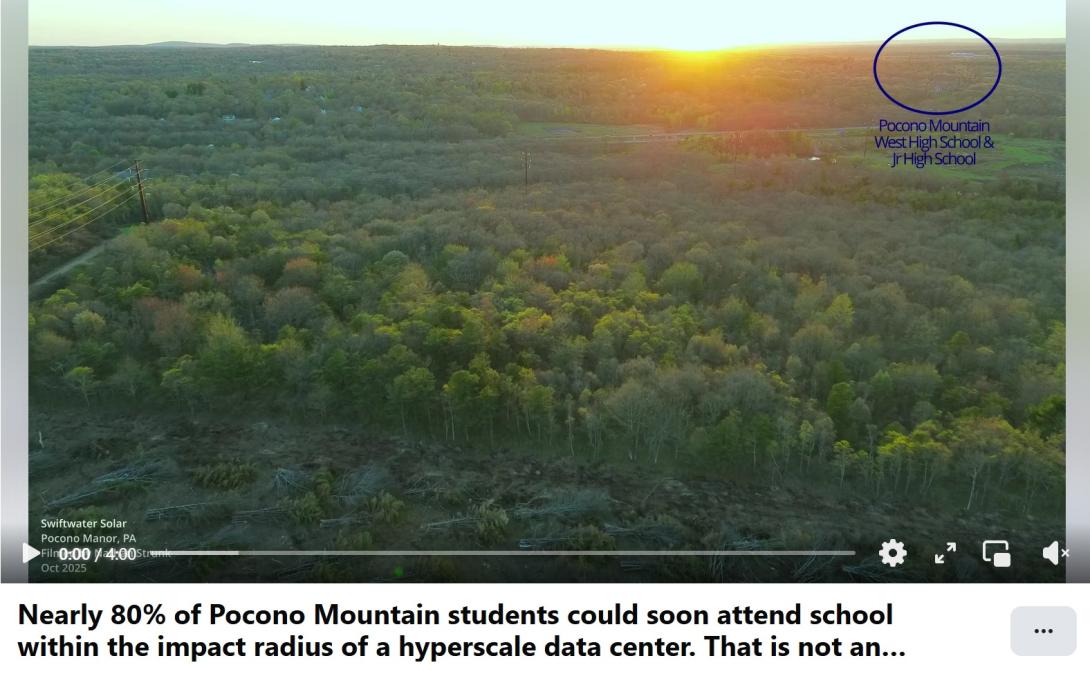
Nearly 80% of Pocono Mountain students could soon attend school within the impact radius of a hyperscale data center. That is not an exaggeration, and it should stop every parent, taxpayer, and elected official in this region. Based on current district enrollment numbers, roughly 3,520 students on the East campus, about 3 miles from the Pocono Manor property, 2,203 students on the West Sullivan Trail campus, about 1.8 miles from the proposed site, and students in the communities that feed Tobyhanna Elementary Center near the separate Glacial Till project outside of the Arrowhead lake community are now part of a much bigger question about what kind of development we are allowing around our schools. Altogether, about 6,274 of our 7,911 and growing number of students, nearly 80% of the entire district, could be directly or indirectly affected by hyperscale data center development within our community. These are not dots on a map. These are our children, teachers, staff, bus routes, wells, roads, water systems, emergency services, and taxpayers. The suggested Pocono Manor hyperscale data center campus near the Kalahari Resort & Waterpark would place massive industrial infrastructure within a few miles of both of our district's largest campuses. Before we reduce this to “economic development,” let's make sure the public understands the scale: this isn't a small tech building. This is hyperscale infrastructure being pushed into the middle of a school district. If water, stormwater, chemicals, traffic, power demand, noise, emergency response, or environmental mitigation becomes necessary, the cost will not stay neatly on the developer’s side. It could land on the people who live here, pay taxes here, and send their children to school here.
Many people still don't understand what is being proposed throughout the Poconos. This is how a place changes without people realizing it at first. A forest becomes a clearing. A farm becomes a staging area. A school becomes surrounded. A mountain becomes infrastructure. A community is told each project is separate, each concern is premature, and each decision is too small to fight, until the place we call home no longer feels like home. The public still deserves to know the actual site boundaries, the total acreage, the number and size of buildings, the total electric demand, the cooling method, the projected gallons of water per day, the source of that water, the effect on wells and groundwater, the generator and fuel storage plan, the noise levels, the lighting impacts, the construction traffic, the school bus route impacts, the emergency response needs, and whether any public tax breaks, subsidies, LERTA, TIF, PILOT agreements, grants, or other incentives will be requested now or later. Until those questions are answered in public, nobody should be asked to blindly trust that this will be fine.
This is especially urgent because Pocono Mountain is not watching this from the sidelines. Our school district is sitting in the blast radius of decisions being made right now. This reaches into the daily life of the district: morning drop-offs, afternoon bus runs, athletic events, after-school programs, emergency planning, utility bills, capital projects, water testing, student health, and the neighborhoods our schools serve. The suggested Pocono Manor hyperscale data center campus near the Kalahari Resort & Waterpark’s property is close to both major sides of the district, so silence from public officials is not an option. How many warnings do we need before we admit this is not normal development? How much power will it demand? How much water will it use? What happens to our wells, aquifers, streams, roads, and school budgets if the promises do not match the reality? What happens if the developer comes back later, asking for tax breaks, while homeowners and school taxpayers are left carrying the risk and financial burden? And why should the Poconos accept a project where the profits leave, the permanent jobs are few, and the consequences stay right here with our children, our residents, and our future?
The attached video shows the deforestation associated with the Swiftwater Solar project. That land did not clear itself. Those trees did not come down by accident. That mountain did not get stripped for nothing. Residents are already seeing dirt and mud washing down the mountain and degrading water quality in local ponds and streams, and this is only the first stage of what could become a much larger industrial transformation of the Poconos. I will be careful and responsible with my words. I am requesting records, reviewing documents, and confirming every connection before stating it as fact. But the public has every right to ask whether the solar field, the utility planning, and the data center push are part of the same larger buildout. The public has every right to demand the full paper trail. If this infrastructure is being built to serve a future data center, then say it. If it is not, then prove it. Either way, we deserve transparency before more of our mountains, forests, streams, and communities are carved up in the name of somebody else’s return on investment that we will never see a dime of in this lifetime or the next.
That is why my hard line is simple. THE POCONOS ARE NOT AN INVESTMENT. The Poconos are our home. They are not a portfolio. They are not a speculative play. They are not a backup site for companies that want cheap land, water, power, and political silence. They are not a dumping ground for warehouses, data centers, industrial solar fields, and whatever else gets sold to us as “progress” after the real decisions have already been made. The deciders bought. Our future should be built around mom and pop businesses, local entrepreneurs, tourism, outdoor recreation, agriculture, trades, startups, schools, conservation, history, and community driven growth, not massive outside projects that consume land, water, power, and public attention while offering very little, if anything, that actually strengthens the people who live here.
This is not anti-business. I am tired of that lazy argument. Being pro-Pocono is not anti-business. Being pro-education is not anti-business. Being pro-water is not anti-business. Being pro-resident is not anti-business. I want growth that fits our region, respects our communities, protects our natural assets, and actually benefits the people who live here. A locally owned restaurant, a family business, trade startups, a farm, a small manufacturer, and a technology startup started by local graduates, that is real economic development. A giant data center dropped into a resort and school community, drawing huge amounts of electricity, raising unanswered questions about water, requiring major infrastructure, and potentially changing the landscape of this land we call home forever, is not the same thing. We do not have to accept every project just because someone calls it an investment.
This is bigger than one township, and it is bigger than the excuse that “our hands are tied.” I am calling on school board members, township supervisors, borough councils, county commissioners, state representatives, state senators, candidates, and the Governor to take this seriously now, not after the land is cleared, not after the permits are issued, not after the water studies are buried, not after the utility upgrades are locked in, and not after residents are told it is too late. Monroe County’s leaders have more power than they often let on. The County Commissioners help shape economic development priorities, grant strategy, and the public direction of agencies like the Pocono Mountain Economic Development Corporation. If PMEDC is actively supporting data center growth in Monroe County, then the Commissioners cannot pretend they are just spectators. Taxpayers should not fund an economic development office that works against the long-term interests of the people who live here, especially as it is funded by our own tax dollars. If the Commissioners cannot limit, redirect, or stop PMEDC’s support for data centers, then they should seriously consider removing PMEDC as the county’s grant administrator and bringing that role back under direct county control, as other counties have done and as Monroe County has done in the past. Saying “it is the law” is no longer enough. Laws are made, challenged, changed, and improved when they no longer fit the realities communities face. Even school districts have had to make hard decisions to protest state mandates when those mandates harm local taxpayers. This is not the time for elected officials to shrug and hide behind process. If state law is forcing municipalities to accept projects that threaten schools, water, residents, and the future of the Poconos, then our county and municipal leaders should be the ones loudly demanding that Harrisburg change the law. They should be passing resolutions, withholding support, refusing tax breaks, demanding hearings, challenging the state, and making it politically impossible to force data centers into communities that do not want them.
Governor Josh Shapiro also needs to hear this clearly. It is not acceptable for Amazon executives and major corporate players to get cushy, high level meetings that residents, school communities, environmental groups, and families can't get. Those who will live with the consequences are left fighting through township agendas, Facebook posts, rumors, and Right-to-Know requests just to find out what is happening in their own backyard. If Pennsylvania is going to have a serious conversation about data centers, AI infrastructure, water, power, and economic development, then the people of the Poconos deserve a seat at the table before the decisions are made, not a microphone after the damage is done.
And yes, primary elections are tomorrow. That matters. Every voter should be asking candidates at every level, of every party, where they stand on data centers, warehouses, water protection, school impacts, utility costs, tax breaks, and local control. Do not accept vague answers about “jobs” and “economic growth.” Ask whether they support this specific Kalahari area data center. Ask whether they support Glacial Till. Ask whether they support Covington and every other data center proposal that threatens our students, residents, livelihoods, natural assets, and future. Ask whether they will oppose tax breaks. Ask whether they will demand water studies. Ask whether they will stand with school communities. Ask whether they believe the Poconos are a home or just another investment opportunity.
The next steps are clear, and they need to reach every level of government that has a hand in shaping what the Poconos becomes next. Residents should be contacting Tobyhanna Township, Pocono Township, Coolbaugh Township, Paradise Township, Tunkhannock Township, Smithfield Township, Middle Smithfield Township, Mount Pocono Borough, the Monroe County Commissioners, the school districts, state legislators, candidates, the Governor’s office, and the Pocono Mountains Economic Development Corporation. This isn't just a problem for the township where the next hearing is held. Every municipality in Monroe County should be paying attention, including Barrett, Chestnuthill, Eldred, Hamilton, Jackson, Polk, Price, Ross, and Stroud Townships, along with Delaware Water Gap, East Stroudsburg, and Stroudsburg Boroughs, because once this kind of development model takes hold, no community should assume it is safely outside the impact zone. Demand public hearings. Demand full disclosure. Demand water studies. Demand school impact reviews. Demand traffic studies. Demand noise studies. Demand emergency response plans. Demand utility impact reviews. Demand that no public tax breaks, LERTA, TIF, PILOT agreements, KOZ treatment, grants, or other public support be used to help data centers shift risk onto local taxpayers. Demand that every elected official take a public position, not a vague position about “growth,” but a clear position on hyperscale data centers in the Poconos. People should also stay informed through the groups and organizations that are already closely tracking these issues. I cannot personally speak for or attach myself to every group, but I do follow and support the work being done by residents and advocates who are keeping the public informed, including Coolbaugh Township Citizens for Responsible Growth, PennFuture, Pocono Data Center Resistance (East Stroudsburg - Smithfield Township), local watchdog pages, township meeting trackers, environmental advocates, and other community groups organizing around data centers, warehouses, water, and responsible growth. These are often the places where residents first see meeting notices, maps, filings, videos, public comments, and updates before the broader public realizes what is happening. Follow them, compare what they share with official township agendas and public records, show up to meetings, ask questions, and do not let this issue disappear between votes. I will also request records, review documents, track meetings, and share updates as I verify information.
The proposed data center overlay may include or directly border Pocono Elementary Center property, and that should be a wake-up call to every elected official who thinks the only answer is “our hands are tied.” They are not. Not at the township level, not at the county level, not at the school district level, and not at the state level. Every public body has a lane, a tool, a pressure point, or a responsibility to act when development threatens the people they represent. For Pocono Mountain, that means we should not wait until a developer makes an offer, until someone calls school land “unused,” or until the public finds out too late that land around a school was left vulnerable. There are real options, including deed restrictions, restrictive covenants, conservation easements, subdivision, or a hybrid approach that keeps the district building and operational areas flexible while protecting the land behind and around the building for school, environmental, stormwater, recreational, and community use. Subdivision does not have to mean sale. It can be used as a protection tool to separate vulnerable land, preserve wooded buffers, protect access and maintenance areas, support trails, outdoor classrooms, environmental education, recreation, art installations, and community open space, and make clear that public land will not become a future data center, warehouse, utility-scale energy site, or industrial support property. I plan to bring this issue forward and ask the district to investigate these protections and, if appropriate, request that Pocono Mountain study, develop, and plan a land-protection strategy for PEC and any other vulnerable district-owned property. The larger point is this: elected officials do have options, and the public deserves to know that. “It is the law” or “there is nothing we can do” is no longer good enough. Laws can be challenged. Zoning can be amended. Public land can be protected. Tax breaks can be rejected. Resolutions can be passed. Records can be demanded. Pressure can be applied. And if any elected official at any level cannot find a single tool available to defend schools, water, public land, and the people who live here, then they are not looking hard enough.
This is the moment to slow this down, expose what is still unknown, and push to stop these projects before the Poconos are permanently changed for the worse. The Pocono Manor data center, Glacial Till, Covington, Smithfield Gateway, and every other proposal like them must be treated as what they are: a direct threat to our schools, our residents, our water, our environment, our economy, our way of life, our future, and our home. The local environment is our lifeblood.
THE POCONOS ARE NOT AN INVESTMENT.